|
National
Taiwan University and National Taiwan University Hospital
http://w3.mc.ntu.edu.tw/
 |
Established
in 1897, the National Taiwan University College
of Medicine (NTUCM) has trained more than 10,000
physicians. Approximately 60 percent of her graduates
remained in Taiwan. In addition to offering the
Doctor of Medicine (M.D.) degree and Doctor of
Dental Surgery (D.D.S.) degree, the School of
Medicine collaborates with the basic departments
of the Graduate Institutes in an 11-year program
leading to the combined M.D./Ph.D. degree. |
The
hospital started operation on June 20, 1895, and
has more than 4,000 employees serving approximately
2,000 inpatients and 6,000 outpatients daily. The
hospital remains one of the best-known and highly
renowned medical centers in Taiwan.
The hospital was designed to support the concept
of patient-centered care, a system in which treatment
is delivered at the bedside whenever possible. The
hospital endeavors to provide appropriate, effective,
and compassionate care that is accessible, affordable,
and culturally sensitive, and in all these respects
it serves as a model to emulate for other hospitals
and clinics across the nation.
The Medical
Center is committed to the principle of free research,
i.e., research undertaken from purely scientific
motives, but is also deeply involved in applied
research in collaboration with both the biotechnology
industry and the public sector. Collaborative studies
between the College, the Hospital, and other institutions
both in Taiwan and in other countries, in a variety
of fields, such as oncology, neuroscience, cardiovascular
disease, hepatitis research, and molecular genetics
are conducted actively.
.............................................................................................................................. |
Chang Gung University
and Chang Gung Memorial Hospital
http://www.cgmh.com.tw/
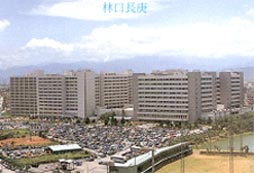 |
Chang Gung University
was established in April 1987 as the Chang Gung
Medical College. The University currently consists
of the College of Medicine, College of Engineering,
and College of Management; under which are 9 undergraduate
schools. Approximately 400 full-time and 250 part-time
faculty teach the University; students number more
than 3,600. |
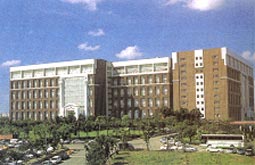 |
In pursuit to provide the people
of Taiwan with high quality healthcare, Formosa
Plastic Group Chairman Yung-Ching Wang and President
Yung-Tsai Wang established Chang Gung Memorial Hospital
(CGMH) in 1976 in memory of their father, Mr. Chang-Gung
Wang. |
During the early periods of its
establishment, CGMH had played the role as a mediating
center that introduced modern medical knowledge
and technologies from around the world to Taiwan,now
it aspires to become a world-class medical center.
Our physicians, nursing staffs and medical allies
work closely as a team to provide our patients with
complete physical, psychological and social care.
Moreover, in order to meet the people's growing
demands for medical services, our hospitals were
built in Keelung, Chiayi and Kaohsiung following
those in Taipei & Linkou. Also, Chang-Gung Institute
of Nursing and Chang-Gung University were established.
The current service beds are approximately 7000
beds. The University and the Hospital work effectively
together by complementing each other and its collaborating
facilities of both basic research and clinical medicine.
..............................................................................................................................
|
Veterans General Hospital
and National Yang-Ming University
http://www.vghtpe.gov.tw/
 |
In 1971 an ‘Ad hoc
committee for The Establishment of The National
Yang-Ming Medical College’ was formed under the
auspices of the Ministry of Education. The first
building, The ‘Experimentation’ Building, was completed
in 1974. The following year, 1975, Yang-Ming Medical
College herself, with the founding mission of ‘upgrading
grass-root medical care’, was formally established.
|
| In the 23 years since
her founding and under the concerted efforts of
dedicated Yang-Ming members, Yang-Ming has enjoyed
a robust growth. An additional 22 graduate research
institutes, of which 11 are currently offering Ph.D.
programs, have been established.
|
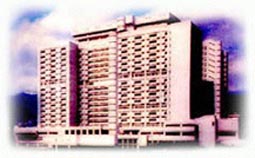 |
The Taipei Veterans General Hospital,
since its founding on November 1, 1959, has been
dedicated to three equally important functions:
medical education, medical research, and medical
services.
|
| In the beginning, Taipei VGH had
600 beds, and treated some 200 outpatients daily.
Gradual expansion of the hospital afterwards has
made more room for more beds and better services
for more people. Now Taipei VGH has 2,737 beds.
In October 1982 and October 1990, at central and
southern areas of Taiwan, VGH established another
two affiliated general hospitals, one in Taichung
and the other in Kaohsiung. The former became independent
of Taipei VGH in July 1988 while the latter followed
suit on July 1, 1993. The Taichung VGH is equipped
with 1,359 beds and has been medical center since
1988. The Kaohsiung VGH is equipped with more than
1200 beds and has been medical center since 1993.
..............................................................................................................................
|
National Cheng Kung
University and Hospital
http://140.116.253.119:9281/nckm/index.htm/
 |
In September, 1980,
Mr. Shia Han-Min, former president of National Cheng
Kung University (NCKU), proposed the establishment
of NCKU Medical Center, including the NCKU Hospital.
The proposal was made on the basis of two goals:
(1) to expand the NCKU into a comprehensive
university;
(2) to upgrade the medical standard in southern
Taiwan and to balance the medical
gap between northern and southern Taiwan.
|
|
Approval for establishment of the Hospital
was granted in 1981 and the ground-breaking ceremony
was held on February 15, 1985. After seven years
of planning and 40 months of construction, the
NCKU Medical Center was completed and opened for
service on June 12, 1988. The Department of Health
officially designated it as a medical center on
July 1, 1993.
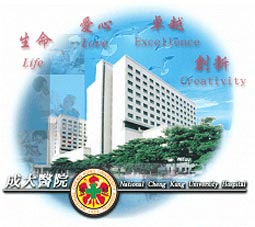
The NCKU Medical Center lies in the Jian-gno
Campus of NCKU, on the block surrounded by Hsiao-Tung
Road, Sheng-Li Road, Dung-Feng Road, and Chang-Rong
Road, covering an area of 7.4 hectares, including:
(1) The NCKU Medical College: a building of 12
stories above the ground and one
basement, 54,099 M2 (16,365 pings) in total.
(2) The NCKU Hospital: a building of 12 stories
above the ground and a two story
basement, 112,860 M2 (34,140 pings) in total.
Mission of the NCKU Hospital
The Hospital is dedicated to
1. Offering excellence in medical services.
2. Offering clinical teaching and internship.
3. Promoting medical research and development.
4. Assisting the development of local medical
units and institutions.
5. Hold continuous medical education program
for medical personnel.
|
|